
- All
- Product Name
- Product Keyword
- Product Model
- Product Summary
- Product Description
- Multi Field Search
Email: sales@njrecgroup.com
Views: 0 Author: Site Editor Publish Time: 2025-09-18 Origin: Site
Fog, salt spray and persistent humidity place severe stress on transmission networks. Traditional suspension insulators often struggle under these conditions, leading to surface contamination, leakage currents, and flashover risk. That is why utilities and grid operators frequently evaluate whether a fog type glass insulator is the most reliable option. In this article, we will explain what fog-type designs are, how they resist moisture-driven failures, and when they should be chosen over standard or double-shed glass insulators. As one of the leading suppliers in this field, Nanjing Rainbow Electric Co., Ltd. (NJREC) provides a full portfolio of glass insulator solutions adapted for coastal and humid regions.
A fog-type glass insulator differs from standard suspension units mainly in its shed geometry. The shed is shaped with a more compact profile and deeper overhang to maximize creepage distance along the wet surface. By narrowing the air gaps and elongating the leakage path, these insulators resist the continuous conductive film that fog and salt can produce. The overall result is better resistance against flashovers in climates where moisture lingers on the insulator surface for extended periods.
Fog-type designs still rely on the same toughened tempered glass material used in standard insulators. During manufacturing, the glass undergoes a controlled cooling process that increases mechanical strength and provides excellent dielectric performance. NJREC produces fog type glass insulators using advanced tempering and quality-control methods, ensuring resistance against mechanical stress, long-term durability, and excellent optical visibility for inspectors. Toughened glass not only resists breakage but also allows instant detection of damage, as shattered pieces fall away without compromising the rest of the string.
On any insulator exposed outdoors, airborne particles such as dust, salt crystals, and industrial pollutants will gradually settle on the surface. Under dry conditions, this pollution has little effect. However, when fog, drizzle, or condensation occurs, these deposits dissolve into a thin moisture film. This film becomes conductive, creating a leakage path across the insulator. If the leakage current grows strong enough, a flashover can occur, leading to outages. That is why creepage distance—the total path along the insulator surface—is a critical design parameter for fog and coastal environments.
Fog-type glass insulators are not universally required, but in certain regions they provide substantial reliability gains. Coastal transmission lines exposed to sea salt spray are one clear example. River estuaries and delta zones, where humidity remains high and mist forms frequently, are also high-risk. Mountain passes and valleys with frequent fog layers also benefit from fog-type units. In such conditions, standard glass insulators may fail prematurely, while fog-type designs provide the longer creepage path and geometry needed to prevent flashover.
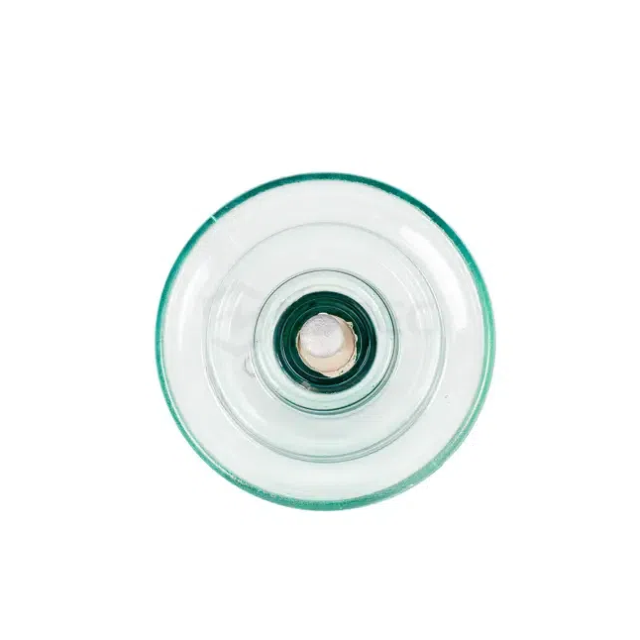
When selecting fog-type glass insulators, engineers should evaluate creepage distance requirements according to pollution severity class. Utilities typically specify a minimum millimeter-per-kilovolt creepage ratio. Fog designs achieve higher values compared to standard insulators, often by 25–40%. NJREC offers models tailored to different pollution classes, giving procurement teams the flexibility to match local grid conditions.
Glass surfaces are naturally hydrophilic, meaning water spreads into a film rather than forming droplets. This is why many utilities consider RTV (Room Temperature Vulcanized) silicone coatings in addition to fog-type geometry. RTV silicone provides hydrophobicity, causing water to bead up and reducing continuous conductive films. Some networks apply RTV coatings selectively, for example only on the bottom sheds or on insulators installed in the most polluted coastal zones. NJREC manufactures both standard fog-type glass insulators and RTV coated glass insulators, allowing utilities to balance cost and reliability.
Procurement specifications should include parameters for acceptable leakage current performance under artificial fog or salt-fog testing. Vendors can provide laboratory and field-test data that illustrate how their fog-type units perform under simulated coastal environments. NJREC’s products are tested to international standards, giving utilities confidence in their long-term service life. Requesting leakage current curves, pollution withstand test reports, and hydrophobicity retention studies can help decision-makers select the right design.
Multiple field studies have shown that RTV-coated fog-type glass insulators reduce leakage current and significantly lower flashover rates in coastal networks. The hydrophobic layer interrupts the conductive path, while the fog-type geometry provides a longer leakage distance. Together, they create a dual-protection effect. Industry surveys confirm that maintenance intervals can often be extended, reducing the need for frequent manual washing.
Consider a transmission line crossing a coastal estuary where salt spray was causing repeated flashovers on standard suspension strings. After replacing several spans with fog-type glass insulators, flashovers decreased sharply. In the most exposed spans, an additional RTV coating was applied, resulting in stable operation through multiple fog seasons. This illustrates how utilities can adopt a layered approach: starting with fog-type geometry and upgrading with RTV where pollution levels demand extra protection.
When should engineers choose a fog-type glass insulator over alternatives? As a general rule, fog-type is preferred for regions with persistent fog, mist, or coastal humidity. Double-shed glass insulators are more suitable for areas with heavy industrial or dust pollution, where different contamination patterns appear. RTV coated glass insulators are best for extreme coastal or desert zones where even fog-type alone may not suffice. NJREC provides all three options—standard, fog-type, and double-shed—so procurement teams can make side-by-side comparisons.
Even the best fog-type insulator requires routine inspection. Utilities in coastal regions often schedule visual inspections twice a year, with additional cleaning if leakage current or salt deposit levels exceed threshold values. Glass provides the advantage of easy visual detection of damage, making it straightforward for field crews to assess condition. For lines exposed to severe salt spray, annual water-washing or live-line cleaning may still be required.
Before large-scale installation, it is recommended to perform sample testing of fog-type insulators under artificial pollution conditions. Acceptance criteria should cover mechanical load rating, glass quality, and electrical withstand tests. NJREC works with utilities to provide testing data and certifications, ensuring insulators meet international and regional standards. A disciplined procurement process reduces long-term risk and guarantees that the installed solution delivers the expected reliability.
For transmission and distribution lines in coastal or high-humidity regions, a fog type glass insulator often provides the most cost-effective protection against flashover. When paired with RTV coatings in extreme salt-fog conditions, they deliver even stronger reliability. Compared to standard and double-shed alternatives, fog-type designs balance performance and maintenance requirements. Nanjing Rainbow Electric Co., Ltd. (NJREC) manufactures a complete portfolio of glass insulators—including fog type, double shed, and RTV coated versions—ensuring utilities can select the right product for their specific environment. To discuss your project and receive tailored recommendations, contact us today.


