
- All
- Product Name
- Product Keyword
- Product Model
- Product Summary
- Product Description
- Multi Field Search
Email: sales@njrecgroup.com
Views: 0 Author: Site Editor Publish Time: 2026-07-05 Origin: Site
High-voltage transformer failures frequently stem from bushing insulation breakdowns. Component selection becomes a critical risk management decision for any asset manager. We see the power industry actively transitioning away from traditional oil-impregnated units. Modern grids demand dry-type technologies to meet strict safety and reliability mandates. Asset managers face increasing pressure to eliminate fire hazards. They must also reduce routine maintenance demands to optimize workforce deployment. Dry-type components address these specific operational challenges directly.
You need an evidence-based framework to evaluate these modern components properly. Procurement and engineering teams must align on exact technical requirements. They must also select a highly qualified manufacturing partner. We designed this guide to provide that exact framework. You will discover the operational advantages of solid epoxy resin structures. We cover strict storage protocols necessary to prevent moisture damage. You will also learn how to validate supplier credentials effectively for long-term grid stability.
Resin Impregnated Paper (RIP) technology eliminates oil leakage and fire hazards, drastically reducing lifecycle maintenance costs compared to legacy systems.
Direct comparison models show RIP outperforms OIP in partial discharge limits and thermal stability, though it requires strict moisture-control during storage.
Selecting the right supplier hinges on verifying verifiable type-test reports, material traceability, and adherence to IEC/IEEE standards.
Procurement evaluation must factor in hidden operational realities, including handling requirements, lead times, and customization capabilities for heavy current applications.
Legacy fluid-filled bushings carry inherent operational risks. Mineral oil degrades over time. Gaskets harden and fail under thermal stress. These failures lead directly to oil leaks. An active oil leak creates immediate environmental compliance issues for substation operators. A catastrophic failure in a fluid-filled unit often results in severe explosions and fires. Such events destroy adjacent transformer infrastructure. They also pose severe risks to substation personnel. You cannot eliminate these risks entirely while using liquid dielectrics.
The industry solved these problems by introducing the dry-type capacitive graded bushing. This technology forms the modern baseline for high-voltage infrastructure. Engineers replace the liquid oil and porcelain structure. They use a solid condenser core instead. Manufacturers wind specialized paper around a central conductor. They insert conductive foils at precise intervals to grade the electrical field. Finally, they impregnate the entire paper core using liquid epoxy resin under deep vacuum.
This core engineering outcome fundamentally changes substation risk profiles. The solid epoxy-resin structure inherently mitigates leakage. There is simply no fluid available to leak. The solid matrix resists internal pressure buildup. This eliminates the catastrophic explosion risks associated with porcelain shrapnel. Furthermore, dry-type technology reduces the physical footprint on modern transformers. The solid core allows for a more compact design. Operators can design smaller, lighter transformers. We see this compactness driving rapid adoption across urban substations.
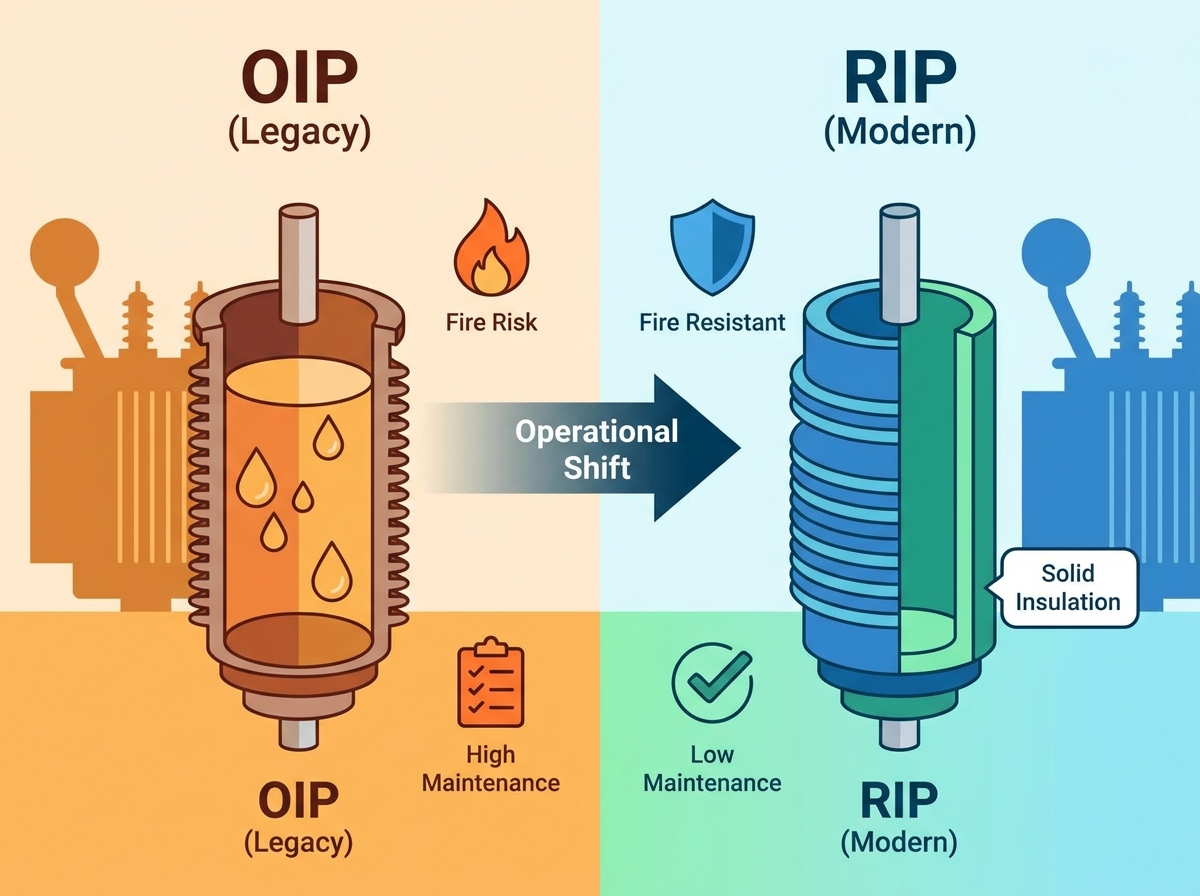
Evaluating insulation technologies requires a clear look at performance baselines. We must compare dielectric strength, thermal operating envelopes, and partial discharge values. The OIP condenser bushing relies on oil to maintain its dielectric strength. Oil performs well electrically but suffers under extreme temperatures. RIP technology maintains exceptional dielectric strength across a much wider thermal envelope. The solid epoxy matrix remains stable during severe load cycling. Partial discharge (PD) limits also differ significantly. RIP systems routinely demonstrate lower PD values. Vacuum impregnation removes microscopic air voids. Fewer air voids mean fewer internal electrical discharges.
We detail the core technical and operational differences in the comparison chart below.
Performance and Operational Baseline Comparison
Evaluation Metric | OIP Technology (Oil-Impregnated) | RIP Technology (Resin-Impregnated) |
|---|---|---|
Partial Discharge Limits | Generally < 10 pC | Often < 5 pC (Superior) |
Thermal Stability | Limited by oil degradation at high temps | High stability across extreme load cycles |
Routine Maintenance | DGA sampling, visual leak checks, oil level monitoring | Visual inspection, annual power factor testing |
Fire Hazard Level | High (Flammable mineral oil) | Low (Self-extinguishing epoxy resin) |
Installation Angle | Restricted (Requires specific vertical angles) | Flexible (Can mount horizontally or at any angle) |
Maintenance realities heavily favor dry-type solutions. OIP units require periodic oil sampling. Technicians must perform dissolved gas analysis (DGA). They must regularly check oil levels through sight glasses. Sight glasses frequently stain or crack. RIP systems eliminate these fluid-based maintenance tasks. Operators only need to perform visual inspections. Technicians conduct periodic power factor and capacitance testing. This simpler routine keeps personnel away from energized equipment. It greatly improves overall workforce efficiency.
Safety and compliance standards now dictate procurement strategies. Modern substation safety regulations heavily penalize fire risks. RIP's fire-resistant nature aligns perfectly with these stringent regulations. Self-extinguishing epoxy prevents fire propagation. OIP's flammability remains a major liability. The primary trade-off involves balancing these operational upgrades against moisture vulnerability. Solid insulation provides an extended operational lifespan. You gain massive reliability improvements. However, you must manage strict storage protocols before installation.
Standard transformer applications cover most procurement needs. However, specific grid scenarios demand specialized engineering criteria. Engineers must evaluate physical stresses and extreme thermal loads differently in these environments. We look closely at structural integrity when penetrating building boundaries.
A high voltage wall bushing faces unique mechanical challenges. These units transfer high-voltage power through physical structures. They connect outdoor switchyards to indoor GIS halls or testing facilities. Structural integrity is paramount here. The unit must withstand massive cantilever forces. Heavy busbars place continuous downward pressure on the terminals. Wind and ice loads multiply this stress outdoors. Manufacturers must validate seismic performance rigorously. Solid epoxy cores offer superior mechanical rigidity. They resist bending moments better than hollow porcelain insulators.
High-amperage environments require different evaluations. A heavy current bushing must manage severe thermal stresses. Massive current flows generate intense heat in the central conductor. Engineers must prevent thermal runaway. Thermal runaway destroys the surrounding insulation matrix quickly. Optimizing conductor sizing is critical. You must choose between draw-lead and solid rod configurations. Draw-lead designs offer easier installation. Flexible cables pull through the hollow tube. However, they limit overall current capacity due to heat buildup. Solid rod designs handle much higher amperage. They provide superior heat dissipation. The solid copper or aluminum rod conducts heat away from the epoxy core efficiently.
Insulation and material quality dictate long-term reliability. Specialized materials determine survival in harsh environments. Specific epoxy formulations provide distinct glass transition temperatures. This dictates how the resin handles expansion and contraction. Outer housings play a massive role in longevity. Legacy units used heavy, brittle porcelain. Modern systems utilize moisture-resistant outer housings. Silicone rubber or composite insulators offer hydrophobic properties. Water beads up and rolls off the silicone sheds. This prevents conductive tracking across the surface. These specialized composite materials reduce weight dramatically. They also eliminate the shrapnel risk during unforeseen failures.
You cannot deploy dry-type technology exactly like legacy fluid-filled units. Solid insulation demands strict handling procedures. Field teams must understand these operational realities to ensure successful commissioning. Mismanagement before energization causes most premature failures.
Transparently addressing moisture ingress vulnerability is crucial. This represents the primary weakness of dry-type condenser technology. The epoxy-impregnated paper core acts like a sponge if exposed to high humidity. Moisture severely degrades the dielectric strength. It increases the capacitance and tan delta values rapidly. Water molecules allow tracking along the paper layers. Once moisture penetrates deeply into the core, you usually cannot dry it out. The component becomes unusable. You must protect the exposed lower terminal end at all costs before installation.
Strict storage protocols prevent this moisture ingress. Field teams must implement specific procedures immediately upon delivery.
Climate-Controlled Indoor Storage: You must store these units indoors. The facility must maintain controlled humidity levels. Never store them exposed to outdoor weather.
Aluminized Protective Bags: The lower portion remains sealed in a specialized aluminized barrier bag. Do not open this bag until the day of installation.
Desiccant Management: Bags contain indicating silica gel desiccants. Technicians must monitor the color of these desiccants through the viewing window regularly.
Vertical Positioning: Store units in a vertical or slightly angled position. Follow the manufacturer's specific crating instructions to prevent mechanical stress.
Installation best practices protect the physical integrity of the unit. Handling guidelines must prevent micro-cracking in the resin. Never apply lifting slings directly to the composite sheds. The silicone rubber will tear. The internal epoxy core might fracture under improper bending moments. Always use the designated lifting lugs on the mounting flange. Use a spreader bar to keep lifting angles completely vertical. Carefully guide the lower terminal into the transformer turret. Prevent any scraping against the grounded tank.
Commissioning requires rigorous pre-energization testing protocols. You must verify internal integrity post-transit. Transport vibrations can cause hidden damage. Moisture might have entered during storage. Technicians must perform baseline capacitance (C1 and C2) checks. They must also measure the tan delta (power factor). Compare these field measurements directly to the factory routine test report. A significant deviation indicates potential moisture ingress or transit damage. Never energize the equipment if these values fall outside acceptable tolerances.
Procuring high-voltage insulation carries significant operational risk. You cannot simply select the lowest bidder. The manufacturing process demands extreme precision. Small deviations in vacuum pressure or resin curing lead to catastrophic field failures years later.
Partnering with a specialized rip condenser bushing supplier reduces this procurement risk. Generalist manufacturers often lack the deep material science expertise required for solid insulation. Specialists dedicate their engineering resources specifically to high-voltage capacitive grading. They understand the nuances of crepe paper tensioning. They know exactly how to manage epoxy exothermic reactions during the curing phase. You need this level of focused expertise.
We recommend following this specific sequence when evaluating manufacturing quality control:
Verify In-House Testing Facilities: The facility must possess a shielded Faraday cage. This ensures accurate, interference-free partial discharge testing.
Audit the Vacuum Impregnation Process: Look for strict automated controls. The system must monitor temperature, vacuum depth, and resin flow rates precisely.
Trace Raw Materials: Request material traceability documentation. The manufacturer must track the exact sourcing of raw electrical grade paper. They must document the specific epoxy formulations and sealing materials used.
Review Cleanroom Conditions: Winding the condenser core must happen in a climate-controlled, dust-free environment. Debris in the paper layers causes localized electrical stress.
Compliance and type testing form the foundation of technical trust. You must mandate verifiable test data. All products must comply fully with IEC 60137 or IEEE C57.19.00 standards. Do not accept internal certificates alone. Look for type-test reports from independent, internationally recognized testing laboratories. These reports validate the fundamental design limits. They prove the equipment survives lightning impulses. They verify thermal stability during maximum current loads. Routine factory tests prove the specific unit you bought meets these design standards.
Finally, evaluate supply chain and scalability. Manufacturing high-quality solid insulation takes time. Evaluate standard lead times carefully. Ask about their global shipping safeguards. How do they crate the units to prevent transit damage? Do they include shock indicators on the packaging? Post-sales technical support capabilities also matter. If your field team encounters an abnormal tan delta reading during commissioning, you need immediate engineering support. A reliable partner provides fast, actionable data interpretation to keep your project on schedule.
The transition to solid dry-type insulation represents a definitive upgrade in grid reliability. Eliminating flammable oil removes a major vulnerability from modern substations. Solid epoxy cores provide superior mechanical strength and excellent partial discharge performance. However, long-term operational success depends heavily on material quality. It also requires uncompromising adherence to proper handling and storage protocols. You must manage moisture risks proactively before installation.
Engineering and procurement teams should take immediate action to secure their supply chains. We encourage you to request detailed type-test reports from potential partners. Conduct a site-specific operational evaluation for your upcoming transformer projects. Compare the maintenance demands of your current legacy units against solid insulation requirements. Initiate technical scoping sessions with shortlisted vendors to ensure they meet your exact mechanical and electrical specifications.
A: A high-quality resin-impregnated paper unit typically exceeds a 30-year operational lifespan. This assumes proper moisture control before installation. Legacy oil-impregnated units have similar theoretical lifespans, but they remain heavily dependent on continuous oil maintenance. Without perfect gasket seals and regular oil intervention, OIP units often fail much earlier.
A: No. You must store them indoors in a climate-controlled environment. Solid epoxy-paper cores remain highly susceptible to moisture ingress before you install them. Keep the lower terminal sealed in its protective aluminized bag. Monitor the desiccant indicators regularly. Outdoor storage voids warranties and risks permanent dielectric degradation.
A: Suppliers prove performance through routine factory testing. They place each unit in a shielded Faraday cage. They apply elevated voltage and measure internal electrical discharges. Buyers should request the certified routine test report for every serial number. It documents exact capacitance, tan delta, and partial discharge values.
A: Yes. The solid epoxy matrix maintains thermal stability in extreme cold, avoiding the freezing issues of oil. For high-seismic zones, the mechanical rigidity of the solid core excels. When paired with a composite silicone outer housing, they resist cantilever stresses and bending moments better than brittle porcelain.


