
- All
- Product Name
- Product Keyword
- Product Model
- Product Summary
- Product Description
- Multi Field Search
Email: sales@njrecgroup.com
Views: 0 Author: Site Editor Publish Time: 2026-06-02 Origin: Site
Power transformer failures often originate at the bushing level. Thermal stress, mechanical failure, or improper sealing usually cause these breakdowns. Selecting the correct high-voltage (HV) bushing becomes a critical risk-management decision for your network. Modern grid infrastructure demands extreme reliability under fluctuating daily load cycles. While composite polymeric options steadily rise in popularity, traditional DIN standard porcelain units remain foundational. They support electrical grids globally. You need them particularly in high-load and heavy-pollution environments where durability is paramount.
This article provides procurement engineers and substation designers with an evidence-based framework. We will explore the technical boundaries of ceramic insulation technology. You will learn how to evaluate, size, and source DIN/EN compliant porcelain units for HV applications. By understanding the mechanical and environmental variables, you can mitigate catastrophic grid failures effectively.
DIN-standard porcelain bushings provide exceptional mechanical load capacity (up to 100KN) and proven longevity in P1-P4 pollution-rated environments.
Modern EN 50180 and EN 50243 standards have largely superseded legacy DIN 42530-42541 specifications, though backward compatibility remains crucial for retrofits.
Effective evaluation requires balancing porcelain’s superior track resistance and cost-efficiency against its weight and sealing vulnerabilities (e.g., flat gasket leaks).
Rigorous OEM quality control—encompassing physical, chemical, and electrical testing—is non-negotiable for mitigating operational risks.
Engineers often navigate a complex web of historical manufacturing standards. Previously, historical norms like DIN 42531, 42532, and 42533 dictated European manufacturing. Today, current European norms like EN 50180, EN 50243, and IEC 60137 have superseded them entirely. However, manufacturers preserved the original physical dimensions intentionally. This design continuity ensures mechanical interchangeability for legacy transformer retrofits. You can upgrade decades-old equipment without modifying the steel tank cutouts.
We must also consider cross-regional engineering differences. Let us contrast DIN/EN design philosophies with ANSI transformer bushing standards. ANSI specifications often demand different mounting flange dimensions to fit North American enclosures. Furthermore, ANSI designs heavily utilize draw-lead configurations rather than rigid bottom-connected setups. You will also notice distinct Basic Insulation Level (BIL) ratings between the two standards. Understanding these variations prevents costly procurement errors during international projects.
Standardizing your components delivers immediate operational benefits. Standardizing on specific DIN/EN profiles reduces the complexity of your Bills of Materials (BOM). It also streamlines logistics for international OEMs. You avoid sourcing obscure, custom-dimensioned parts. A unified standard allows procurement teams to secure bulk pricing and maintain leaner spare part inventories.
Legacy DIN Standard | Modern EN Equivalent | Typical Voltage Range | Primary Application |
|---|---|---|---|
DIN 42530 | EN 50180 (Part 1) | 1kV - 3kV | Low-voltage secondary distribution |
DIN 42531 | EN 50180 (Part 2) | 12kV - 36kV | Medium-voltage distribution networks |
DIN 42532 / 42533 | EN 50243 | 24kV - 52kV | High-voltage primary substations |
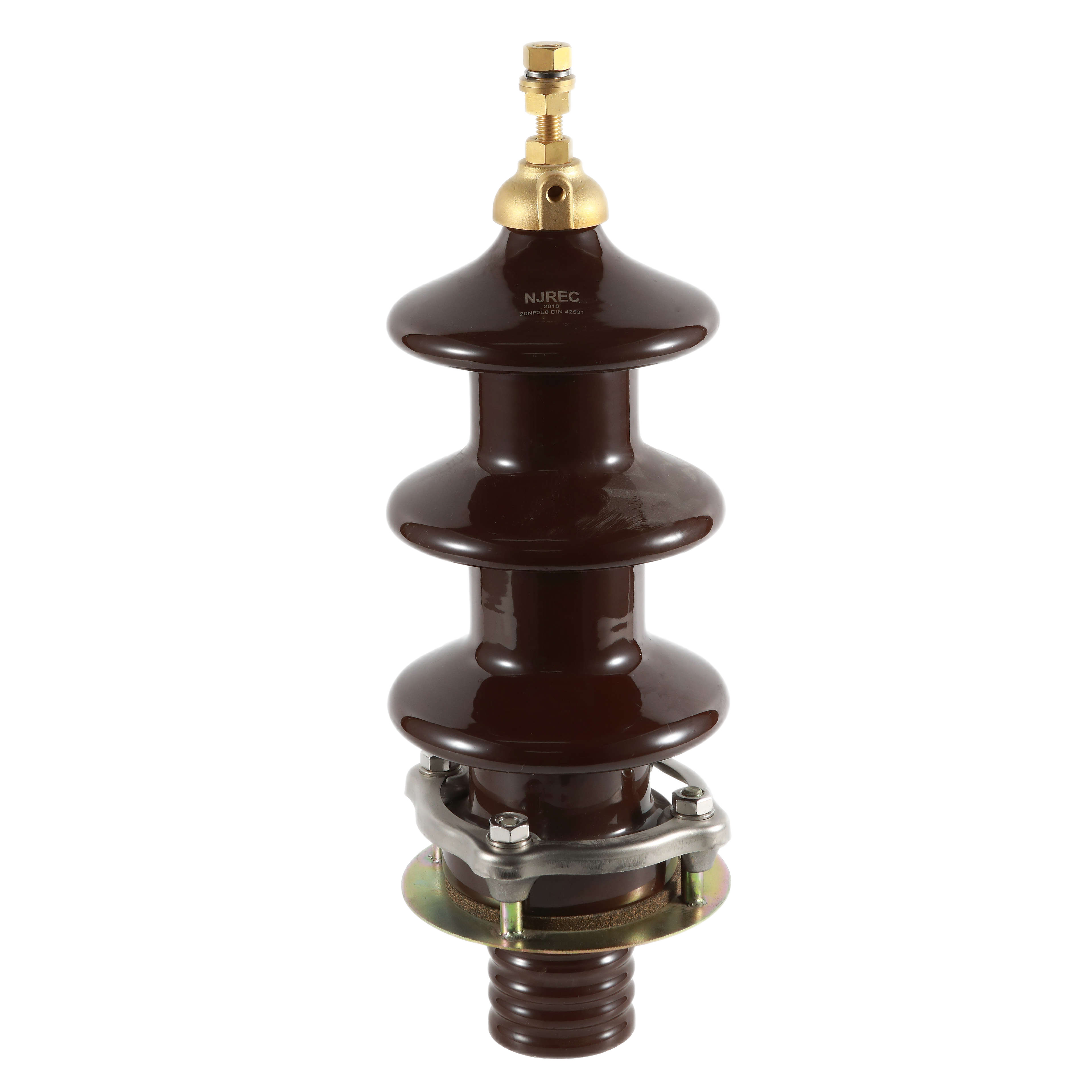
DIN porcelain units cover a broad and robust operational bandwidth. They typically span voltages from 1kV up to 52kV. Current ratings range from a modest 250A up to heavy-duty 12,500A applications. You specify ceramic when your network demands continuous high-current transmission. The material handles intense thermal cycling better than many entry-level polymer alternatives.
Consider the precise insulation and heat dissipation mechanics at play. The structure relies on a fascinating physical mechanism. Transformer oil fills the narrow space between the rigid copper rod and the ceramic shell. This fluid acts simultaneously as a robust electrical insulator and a heat sink. It absorbs high-current thermal energy rapidly. It then transfers that heat to the external ceramic, which dissipates it into the surrounding air.
We classify these DIN ceramic components strictly as "live-front" designs. They feature bare metal terminals exposed to the environment. This classification dictates specific installation parameters. If your system voltages exceed 35kV-52kV, requirements change drastically. Specific enclosed padmount applications also dictate different engineering approaches. Engineers must account for adequate air clearance distances to prevent arcing. If you cannot provide sufficient clearance, you must transition to fully insulated condenser-type variants.
To optimize performance boundaries, follow these best practices:
Verify the maximum continuous operating voltage (MCOV) of your network before selection.
Calculate expected thermal peaks during summer load cycles.
Ensure the internal oil channels remain unobstructed during installation to maintain convection cooling.
Confirm phase-to-phase and phase-to-ground air clearances meet IEC 60137 guidelines.
We must evaluate material choices objectively based on field outcomes. Ceramic insulation provides unique advantages and distinct vulnerabilities. Let us examine mechanical strength first. Porcelain delivers an exceptionally high mechanical stress tolerance. It can easily withstand up to 100KN of cantilever force. This characteristic makes it superior to lighter composite materials. You need this extreme rigidity in environments facing severe wind loads, heavy ice accumulation, or seismic activity.
Surface degradation remains another critical evaluation factor. Ceramic offers permanent resistance to UV tracking. Polymers can chalk or erode under intense ultraviolet radiation over decades. Porcelain resists surface degradation entirely in heavy dust and moisture. It performs exceptionally well in P1-P4 pollution grades (as defined by IEC 60815). The hard, glazed surface allows rain to wash away conductive contaminants effectively.
However, we must acknowledge the implementation realities and vulnerabilities. Flat gaskets represent the absolute weakest link in solid assemblies. Uneven nut torque induces oil leaks quickly. Microscopic ceramic surface deviations also compromise the sealing integrity over time. We also face severe fragmentation and weight issues. Catastrophic failures pose dangerous safety realities for substation personnel. Ceramic fragmentation creates hazardous blast zones stretching up to 50 meters. Furthermore, the increased logistical weight complicates site installation compared to modern polymers.
We can contextualize this material choice across other network components. Consider the heavy-duty HV dry wall bushing used in indoor-to-outdoor substation routing. Think about the durable glass insulator or the rugged disc suspension insulator utilized in overhead transmission lines. Each component relies on brittle but chemically stable silicates. Your material selection depends entirely on the specific mechanical use-case and the expected environmental stressors.
Objective Risk Assessment Chart | ||
Risk Dimension | Porcelain Profile | Polymer Profile |
|---|---|---|
Mechanical Rigidity | Excellent (Up to 100KN) | Moderate (Flexible under load) |
UV & Tracking Resistance | Permanent (No degradation) | High (Susceptible to long-term chalking) |
Catastrophic Failure Risk | High (Fragmentation blast zone) | Low (Housing splits, no shrapnel) |
Sealing Reliability | Vulnerable (Relies on flat gaskets) | Superior (Often seamlessly molded) |
Vibration and daily thermal cycling constantly challenge hardware stability. Manufacturers integrate vital design features to combat these forces. Internal ceramic shaping represents a brilliant engineering solution. The interior cavity actively locks terminal bolts firmly in place. This anti-rotation mechanism prevents the central conductor from turning during field installation. It also stops gradual loosening caused by operational vibration.
You must specify appropriate hardware and surface treatments meticulously. We strongly recommend tin or silver-plated copper rods. These specialized treatments prevent galvanic corrosion across diverse, aggressive climates. Bare copper oxidizes rapidly in coastal or industrial atmospheres. For 12kV+ applications, you should always integrate arcing horns. These metallic gaps safely manage dangerous overvoltage transients. They force lightning strikes to flash over the air gap rather than puncturing the ceramic insulation.
Adjusting creepage distance adds critical environmental flexibility. Varying the shed (umbrella) count allows precise tuning. Engineers can customize creepage distances for specific atmospheric stressors. You can extend the leakage path for high-salinity coastal areas. Crucially, you achieve this enhanced protection without altering the fundamental mounting flange dimensions on the transformer tank.
Common mistakes to avoid during configuration:
Failing to specify high-grade NBR or Viton for gasket materials.
Ignoring the altitude derating factor when calculating necessary air clearances.
Over-torquing the central nut, which cracks the ceramic base invisibly.
Selecting a creepage distance too short for the actual site pollution severity.
Sourcing high-voltage components demands a strict procurement methodology. You must define baseline quality assurance (QA) expectations for any tier-one supplier. Shortlisted manufacturers must provide comprehensive, documented batch reports with every shipment. These critical reports must cover exact chemical composition. They must detail porosity tests (such as dye penetration) to prove the ceramic contains no micro-voids. Finally, they must provide documented electrical withstand testing data.
We must address global supply chain realities realistically. Sourcing "like-for-like" legacy DIN sizes presents significant challenges. Requesting obsolete dimensions can sometimes trigger frustrating reverse-engineering delays. Production could stall for months. You should evaluate suppliers directly on their existing mold inventory. A supplier with a deep mold catalog for EN/DIN standards accelerates delivery timelines dramatically.
Ensure your chosen supplier offers extensive customization flexibility. They must modify connection interfaces seamlessly based on your specs. You might need draw-lead instead of standard draw-rod configurations for easier internal tank assembly. They should also provide varied hardware materials. Switching between brass and aluminum flanges helps you match specific insulation coordination requirements accurately.
When auditing a new supplier's capability, focus on these evaluation pillars:
Testing Infrastructure: Do they possess an in-house high-voltage testing laboratory?
Raw Material Traceability: Can they trace the alumina and silica back to the raw material mine?
Tolerance Precision: Do they use CNC grinding to ensure perfectly flat gasket mating surfaces?
Certification: Do they hold current ISO 9001 and ISO 14001 credentials?
We can now summarize the procurement decision matrix clearly. The DIN standard porcelain transformer bushing remains highly viable today. It perfectly suits projects requiring robust mechanical strength and extreme longevity. It also guarantees essential backward compatibility with existing European and global grid assets. Despite the rise of alternative materials, ceramic provides unbeatable UV resistance and load-bearing capacities.
We strongly recommend a proactive next-step action. Engineers should audit their current transformer fleet immediately. Identify all legacy DIN sizes currently in operation. Once mapped, standardize your future procurement around modern EN equivalents. This strategic transition ensures a resilient, reliable, and simplified supply chain for your network infrastructure.
A: The EN 50180 standard unified multiple historical DIN standards for voltages ranging from above 1kV up to 52kV. It modernized testing parameters and material specifications. However, the physical dimensions remain largely identical. This continuity ensures perfect retrofit compatibility for older transformer tanks without requiring mechanical modifications.
A: Preventing leaks requires precise torque application during installation. You must never over-tighten the hardware. You should use high-grade NBR or Viton gasket materials instead of basic cork. Additionally, rely on strict OEM manufacturing tolerances. The porcelain base must be ground perfectly flat to ensure even gasket compression.
A: Yes, they perform exceptionally well in coastal areas. You achieve this by specifying extended creepage distance profiles. Manufacturers add higher shed counts to the ceramic body. This modification easily meets P3 (heavy) or P4 (very heavy) pollution severity requirements, preventing salt-induced surface tracking.
A: No. Porcelain bushings are strictly live-front components. They feature bare metal terminals exposed to the air. Dead-front applications require fully insulated, plug-in style polymeric connectors (like loadbreak elbows). These insulated designs eliminate air clearance requirements completely, making them safe for enclosed public installations.


