
- All
- Product Name
- Product Keyword
- Product Model
- Product Summary
- Product Description
- Multi Field Search
Email: sales@njrecgroup.com
Views: 0 Author: Site Editor Publish Time: 2026-06-03 Origin: Site
Low-voltage (LV) transformer bushings play a strictly critical role in modern power distribution. They must maintain flawless hermetic seals. At the same time, they ensure safe, continuous current transmission in distribution transformers. Specifying an ANSI-compliant bushing requires significant engineering oversight. It is rarely a generic, off-the-shelf purchase. You must consider strict thermal limits. You need to verify specific cantilever strength requirements. Managing high amperage loads demands extreme precision. Choosing incorrect components often leads to catastrophic oil leaks. It causes extended grid downtime. This exact problem consistently plagues substations relying on unverified parts. We designed this guide to help electrical engineers and procurement managers. It provides an actionable, reliable evaluation framework. You will learn how to accurately shortlist, test, and verify components before mass deployment. We will explore material selection. We will analyze terminal configurations and mitigate installation risks. Understanding these factors guarantees safer, highly reliable grid operations.
Standardization limits risks: Utilizing strictly ANSI-compliant bushings guarantees dimensional interchangeability and predictable electrical performance across legacy and modern grid infrastructure.
Spade terminal utility: Multi-hole spade terminals ensure secure, low-resistance connections essential for high-current, low-voltage secondary side distribution (typically 1.2kV, up to 1200A+).
Material longevity: Traditional wet-process porcelain remains the most stable material for weathering, thermal cycling, and tracking resistance compared to organic polymers.
Failure prevention: Proper evaluation must focus on gasket integrity and mechanical tolerances during installation to prevent oil leaks—the leading cause of premature bushing failure.
Utility networks and industrial substations face immense pressure during outages. They cannot afford long lead times. Emergency replacements demand immediate component availability. Custom designs cause severe delays during standard maintenance cycles. Adherence to strict ANSI standards solves this widespread business problem. Standards like ANSI/IEEE C57.19.00 and C57.19.01 dictate exact physical parameters. They strictly ensure uniform mounting flange dimensions. They standardize bolt circles across all manufacturers. They also mandate specific minimum creepage distances. This uniformity guarantees seamless component interchangeability. You can swap parts across different equipment brands without expensive modifications.
Let us contextualize the broader grid ecosystem. A utility might specify a disc suspension insulator to manage extreme overhead line tension. They might rely on a heavy glass insulator for legacy transmission runs. However, the transformer interface itself demands absolute consistency. It strictly relies on standard dimensions. An ANSI transformer bushing unites diverse maintenance protocols. Maintenance teams can replace these standard units rapidly. Predictable sizing minimizes human error during late-night installations. Standardization ultimately builds a more resilient, highly adaptable grid infrastructure. It completely eliminates guesswork from emergency inventory management.
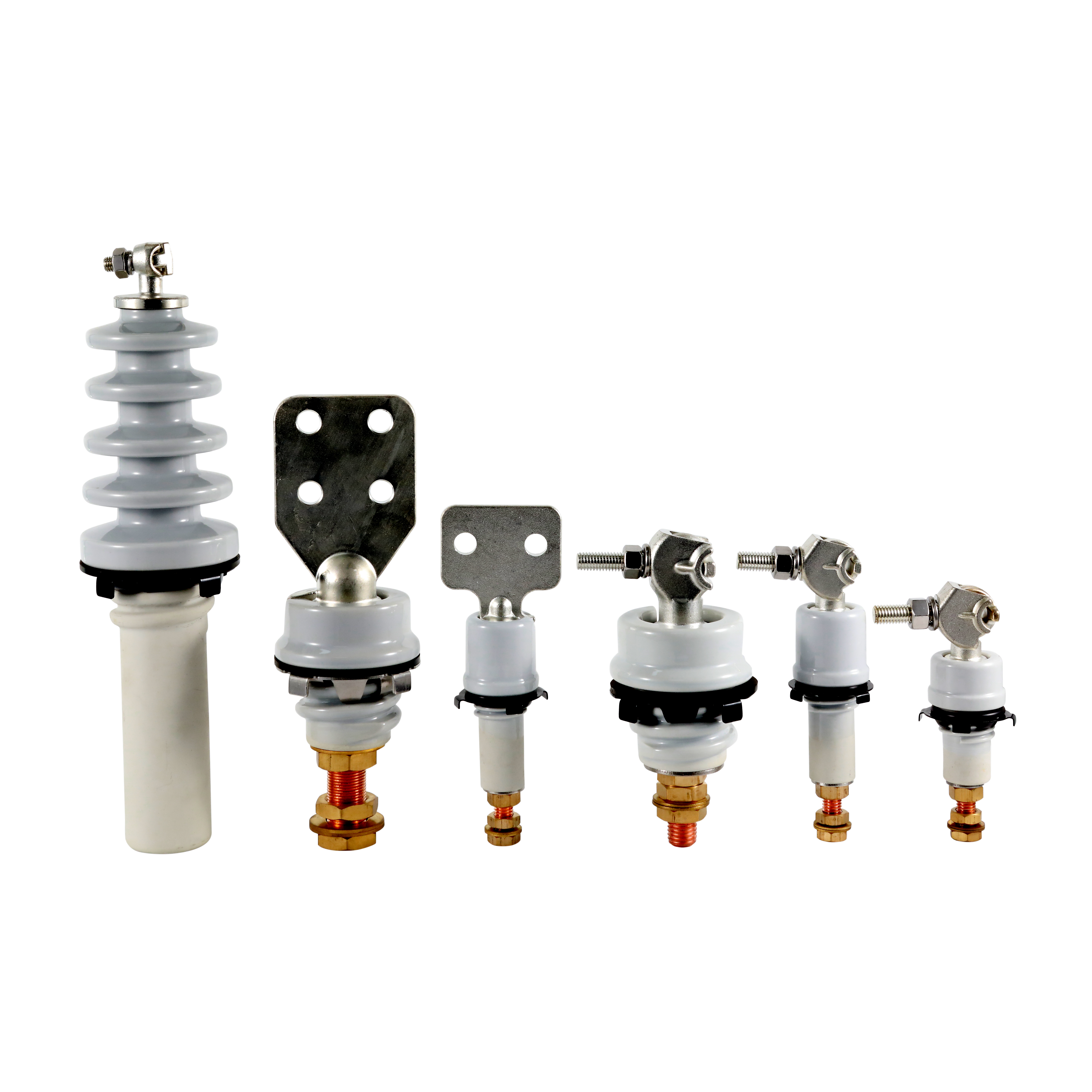
Current carrying capacity heavily depends on the physical dimensions of the terminal. Secondary distribution sides output significant current. We typically see ratings of 400A, 800A, or up to 3000A. The spade thickness directly dictates how safely it handles these loads. Width is equally important. Thicker brass or copper elements actively reduce electrical resistance. This design prevents dangerous heat buildup under maximum load conditions.
Mechanical integrity remains another critical evaluation point. You must carefully assess the transition zone. This is where the round core conductor meets the flat spade terminal. We must evaluate the risk of thermal expansion mismatches. Different metals expand at varying rates when subjected to heavy current. Poor manufacturing leads to invisible micro-gaps at this junction. These tiny gaps increase local resistance. They severely compound the overheating problem over time.
Connection configurations matter immensely for long-term thermal performance. The choice between different NEMA spade designs impacts overall reliability. Multiple bolting points distribute mechanical stress effectively. They significantly reduce surface contact resistance.
4-Hole Spade: Ideal for standard 1.2kV applications carrying up to 800A. It provides a highly balanced clamping force.
6-Hole Spade: Required for heavier current loads exceeding 1200A. It maximizes surface area transfer for critical connections.
Custom Spades: Used only when retrofitting unique legacy busbars. They require extra engineering validation before deployment.
More bolts mean tighter, more flush surface contact. This configuration lowers operational temperatures over decades of continuous use. You avoid localized hot spots. These hot spots otherwise accelerate cable degradation and compromise efficiency.
Thermal and environmental durability drives proper material selection. We constantly see wet-process porcelain outperform newer alternatives. It easily withstands intense UV degradation year after year. It handles extreme temperature shifts without compromising its structural integrity. Corrosive industrial environments quickly degrade organic polymers. Acid rain actively attacks epoxy surfaces. Porcelain remains chemically inert. A fired ceramic glaze seals out moisture permanently.
Tracking and flashover resistance clearly differentiate porcelain from synthetic materials. Porcelain is inherently non-tracking. Aging epoxies or polymers often develop dangerous degradation arcs. Heavy pollution exacerbates these carbon tracks on polymer surfaces. A porcelain transformer bushing sheds water and dirt predictably. This natural washing ensures consistent dielectric strength. It performs exceptionally well in coastal or heavily industrialized zones.
Different grid stages demand vastly different materials. Engineers select highly complex assemblies for primary side voltages. A specialized HV dry wall bushing might utilize resin-impregnated paper (RIP). Some high-voltage designs use gas insulation. They handle extreme internal voltage gradients safely. Low voltage secondary applications present entirely different challenges. They heavily favor the proven mechanical rigidity of porcelain. The material provides unmatched cost-efficiency for 1.2kV applications. It strongly resists bending. It simply lasts longer under constant mechanical strain.
The gasket interface represents the primary failure point. Bushing-to-tank seals degrade rapidly if improperly specified. High-grade Nitrile (NBR) or Viton gaskets are absolute necessities. They strongly resist transformer oil breakdown. They survive extreme temperature fluctuations. Precise compression limits determine long-term seal viability. Over-compressing the gasket destroys its natural elasticity. Under-compressing leaves easy pathways for fluid escape.
Torque specifications require strict field enforcement. Technicians sometimes over-torque connections. They forcefully bolt the terminal to the rigid busbar. This mechanical stress travels straight down into the fragile ceramic body. Porcelain lacks flexibility. Excessive torque causes hairline micro-fractures. These invisible cracks lead to slow, persistent oil seepage. They eventually cause total dielectric failure.
Cantilever load considerations reflect real-world physical stress. Heavy secondary cables pull aggressively on the terminal. Wind forces add stress. Ice accumulation adds massive vertical weight. Structural settling adds constant lateral forces. We must ensure the selected unit exceeds minimum ANSI cantilever strength requirements.
Ignoring torque limits: Over-tightening mounting flanges crushes the gasket and fractures the ceramic core.
Reusing old gaskets: Field swaps require brand-new elastomers to ensure a proper, leak-proof seal.
Unsupported cables: Failing to support heavy cable runs transfers total weight directly to the fragile bushing.
Mismatched hardware: Using incorrect bolt grades causes uneven clamping pressure across the sealing flange.
Vetting suppliers requires a strict analytical framework. Initial savings vanish quickly when unverified components fail. Factory Acceptance Testing (FAT) provides the necessary proof of reliability. Suppliers must provide non-negotiable routine test data. You should demand total transparency.
Routine Test Category | ANSI Requirement Focus | Strict Acceptance Criteria |
|---|---|---|
Dry Power-Frequency Withstand | Dielectric strength validation | No flashover or puncture at rated voltage. |
Routine Pressure/Vacuum Leak | Seal and gasket integrity | Zero pressure drop over the specified test duration. |
Dimensional Verification | Interchangeability compliance | Strict adherence to ANSI/IEEE C57 tolerances. |
Cantilever Strength Test | Mechanical load limit | Endures specified lateral forces without cracking. |
Material traceability guarantees long-term electrical performance. You must require clear documentation. Ask for alloy certificates for the brass or copper elements. This ensures the core conductor meets strict conductivity standards. Poor alloy mixtures contain unseen impurities. They overheat quickly under sustained load.
Supply chain resilience matters just as much as physical testing. Evaluate suppliers based on their ready inventory. They should stock standard ANSI sizes constantly. Assess their lead times for specific hole configurations. Avoid suppliers failing to provide transparent testing data. A reliable partner willingly shares their FAT documentation. They prove their quality control systems work perfectly.
Procuring a low-voltage ANSI unit requires strict technical prioritization. You must demand dimensional interchangeability above all else. Material purity in both the porcelain and the internal conductors is entirely non-negotiable. Mechanical resilience ensures decades of leak-free service. Unverified components look very attractive on initial budgets. However, oil leak remediation quickly negates these tiny savings. Transformer downtime destroys operational efficiency entirely.
Take direct action today to protect your infrastructure. First, mandate complete dimensional drawings from all shortlisted manufacturers. Second, verify material certificates for the porcelain and the spade alloys. Finally, demand comprehensive routine test reports. Do this before issuing any vendor approval. Rigorous upfront evaluation prevents catastrophic grid failures later.
A: They are typically rated for 1.2kV to 3kV. Their current-carrying capacities commonly range from 400A to 3000A. The exact capacity heavily depends on the spade thickness and the internal conductor rod diameter.
A: Porcelain offers superior mechanical rigidity and complete resistance to UV tracking. It boasts a much longer historical lifespan in the field. However, it is heavier and slightly more susceptible to impact damage before installation.
A: Low voltage sides output significantly higher currents. Spade terminals provide a large, flat surface area for multi-bolt connections. This design ensures low-resistance, high-ampere power transfer without causing localized overheating.
A: You should specifically look for Cantilever Strength tests and Power Frequency Withstand Voltage results. Always request Basic Impulse Level (BIL) limits alongside strict thermal cycling and leak test records.


