
- All
- Product Name
- Product Keyword
- Product Model
- Product Summary
- Product Description
- Multi Field Search
Email: sales@njrecgroup.com
Views: 0 Author: Site Editor Publish Time: 2026-07-03 Origin: Site
Procurement engineers and grid managers face intense commercial pressures today. They must constantly balance upfront capital expenditure against long-term grid reliability. Selecting a supplier for power infrastructure is not merely a commodity purchase. It represents a critical risk-mitigation decision. This choice heavily impacts maintenance lifecycles and regulatory compliance. If you choose poorly, network vulnerabilities multiply rapidly. Unexpected outages drain maintenance budgets. Glass offers zero-deterioration properties and unique visual inspectability. These physical traits make it superior for many specific line applications. However, these inherent benefits only materialize if you strictly validate manufacturing tolerances. Purity standards also demand rigorous factory oversight. In this comprehensive guide, we explore how to navigate this complex procurement landscape effectively. You will learn about five key insulator profiles suited for varying extreme environments. We will detail the crucial evaluation dimensions needed to shortlist a reliable manufacturing partner. Understanding these nuances guarantees better network performance.
Supplier vetting requires standard validation: Sourcing must prioritize manufacturers providing transparent Type Test and Routine Test reports adhering strictly to IEC 60383 and ANSI C29.2 standards.
Application dictates the profile: The optimal choice among the top 5 insulator types depends heavily on environmental pollution levels, load requirements, and specific grid architecture.
Total Cost of Ownership (TCO) exceeds unit price: Factoring in breakage rates during logistics, installation efficiency, and long-term dielectric stability is essential for accurate procurement forecasting.
Quality control transparency is non-negotiable: A qualified supplier must demonstrate rigorous in-house thermal shock testing and mechanical load validation.
Insulator failures heavily impact daily business operations. When units fail under electrical stress, they often cause line dropping. These events trigger unplanned power outages across critical infrastructure. Outages lead to elevated emergency replacement expenses and severe operational downtime. We must closely evaluate capital expenditure models during project planning. Glass insulators present unique long-term advantages over composite and porcelain alternatives. They deliver distinct operational savings derived directly from their visual shatter patterns. Maintenance crews do not need specialized diagnostic equipment to find a faulty unit on a tower. A shattered glass disc leaves an intact stub behind. This stub signals immediate replacement needs to ground patrols.
Supply chain realities add another critical layer of complexity to procurement. Dealing with regional intermediaries introduces substantial risks. Direct-to-manufacturer sourcing provides a much safer procurement route. Brokers often obscure factory origin details. They also lack quality control transparency during the production phase. Direct sourcing ensures better control over manufacturing lead times. It guarantees batch consistency across large-scale utility orders. Direct relationships also ensure strict warranty enforceability if manufacturing defects arise later. You need a transparent partner to secure long-term grid stability. Factory audits remain essential before signing long-term supply contracts.
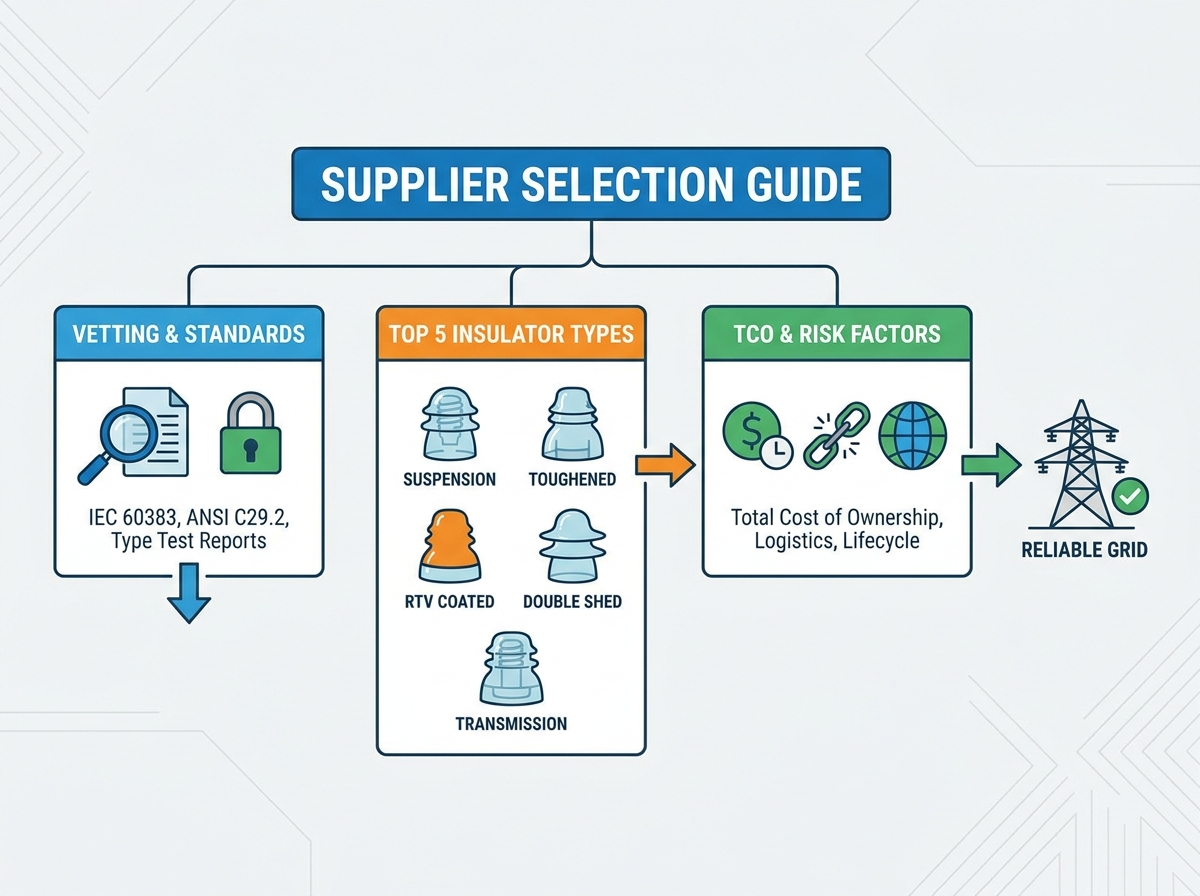
Selecting the right profile requires aligning grid architecture with specific environmental demands. We detail the top five critical options below.
A suspension glass insulator supports vertical load-bearing requirements in standard overhead networks. Engineers evaluate these units primarily based on their mechanical failing load. This critical metric typically ranges from 40kN up to 530kN for heavy-duty applications. Standard ball and socket coupling dimensions ensure seamless interoperability across various grid setups. They perform exceptionally well in standard transmission and distribution lines. In these environments, vertical stress remains the primary physical challenge. Line crews easily string multiple units together to match the required line voltage. You should prioritize suppliers offering galvanized forged steel hardware for the metal fittings. This material prevents premature rusting in humid climates.
Environments demanding high mechanical impact resistance rely heavily on a toughened glass insulator. The core evaluation criteria center around residual stress distribution. The purity of the silica sand also plays a massive role in longevity. You must verify the specific thermal toughening process used by the manufacturer. Rapid cooling creates a compressed outer shell. This process guarantees the famous self-shattering diagnostic feature. When severe dielectric failure occurs, the unit shatters safely into small, harmless fragments. This immediate visual fault identification accelerates maintenance responses significantly. It prevents lingering faults from damaging adjacent hardware components.
Coastal areas and heavily industrialized zones face severe airborne pollution. A RTV coated glass insulator effectively mitigates the resulting flashover risks. Procurement teams must carefully assess the adhesion quality of the Room Temperature Vulcanizing (RTV) silicone rubber. Coating thickness and hydrophobicity transfer mechanisms remain critical evaluation criteria. The silicone layer actively encapsulates conductive contaminants like salt or industrial soot. It preserves the necessary insulating properties even in harsh, salt-heavy environments. Watch out for uneven coating applications. Thin spots create weak points where electrical tracking easily initiates.
Desert landscapes and high-dust regions present highly unique contamination challenges. Standard aerodynamic profiles often accumulate conductive particles on their undersides. A double shed glass insulator solves this pressing issue through creepage distance maximization. The extended, tiered profile heavily enhances aerodynamic self-cleaning properties. Wind easily blows accumulated dust away from the smooth ridges. Rain efficiently washes the remaining dirt off the angled surfaces. This specialized design drastically reduces maintenance washing frequencies in arid landscapes. It saves utilities millions in ongoing operational labor costs.
Long-haul point-to-point networks require incredibly robust engineering solutions. A transmission line glass insulator safely supports extra-high voltage (EHV) corridors. Engineering evaluation focuses strictly on multi-unit stringing compatibility. Corona ring integration also matters for high-voltage applications. Engineers must verify the overall dielectric withstand capability across the entire assembled string. These specific units manage immense electrical stress constantly. They maintain structural integrity over vast, unprotected geographical spans. Always check the steep-front impulse voltage test results for these specific components.
Insulator Profile Comparison Chart
Insulator Type | Primary Use Case | Key Evaluation Metric |
|---|---|---|
Suspension | Standard overhead networks | Mechanical failing load (40-530kN) |
Toughened | High impact environments | Thermal toughening process |
RTV Coated | Coastal/industrial zones | Coating adhesion properties |
Double Shed | Desert/high-dust regions | Creepage distance |
Transmission Line | Long-haul EHV corridors | Dielectric withstand capability |
Identifying a premier high voltage glass insulator supplier demands rigorous, evidence-based auditing. You must look beyond simple product catalogs and glossy marketing materials. Real quality resides in the manufacturing floor procedures.
High-grade raw materials form the absolute foundation of network reliability. Ask how the factory systematically prevents nickel sulfide (NiS) inclusions during the smelting phase. These microscopic impurities represent the primary cause of spontaneous self-shattering in the field. Advanced suppliers utilize highly purified silica sand. They closely monitor continuous furnace temperatures using automated sensors. This strict level of thermal control minimizes inclusion risks drastically. Common mistakes include sourcing cheap, unrefined sand. This practice inevitably leads to high breakage rates post-installation.
Independent laboratory certifications serve as a mandatory procurement requirement. Look for valid, recent credentials from internationally recognized bodies like KEMA or CESI. You must also thoroughly assess the internal Factory Acceptance Testing (FAT) protocols.
Consider these essential best practices for testing evaluation:
Request historic thermal shock testing logs spanning several production runs.
Review steep-front impulse voltage pass rates for your specific required profile.
Verify daily mechanical load validation records on the factory floor.
A manufacturer unwilling to share transparent FAT data presents a severe compliance risk. You should disqualify them immediately.
Large volume utility orders require unwavering dimensional consistency. We evaluate whether the facility utilizes modern, automated pressing machines. Continuous annealing furnaces also play a critical role in internal stress relief. Manual pressing introduces dangerous human error. It creates structural variances between batches. Automated production lines guarantee uniform curing. They ensure exact hardware coupling dimensions across hundreds of thousands of units. Ask the supplier for a virtual or physical factory tour. Observe the pressing line speed and rejection sorting mechanisms.
Procurement success relies heavily on flawless execution during transit and installation. Addressing these logistical risks upfront prevents massive operational delays.
Glass products demand highly stringent logistics planning. Transit breakage destroys project timelines and infuriates installation crews. You must closely evaluate the crating standards implemented by your manufacturing partner.
Verify the strict use of ISPM-15 compliant wood for all international freight shipments.
Ensure the wooden crates feature individual unit buffering using specialized separators.
Confirm the loaded pallets are heavily banded and reinforced for rough maritime shipping.
Proper packing effectively mitigates vibrational damage during long ocean transits. Do not accept loose packing or substandard cardboard dividers.
Grid engineers must address the natural degradation curve of protective silicone layers. RTV coatings do not last forever under harsh elements. Intense ultraviolet radiation and severe weather slowly erode the rubber material. You should establish clear, realistic expectations for re-coating or full string replacement. This typically happens over a 15-to-25-year horizon. Understanding this chemical lifecycle helps infrastructure managers plan future maintenance schedules accurately. It prevents unexpected flashovers when the hydrophobicity finally wears off.
Handling heavy glass strings requires specific safety precautions. Glass strings weigh significantly more than modern polymer alternatives. This substantial weight difference impacts hoisting equipment choices. It also alters standard tower climbing procedures. Line crews require targeted, specialized training to prevent micro-fractures during installation. Dropping or violently striking the glass discs against steel utility towers compromises their dielectric integrity. Educated handling ensures the units perform reliably once fully energized. Always supervise the initial installation phases when working with new crews.
Selecting the ideal glass insulator strictly hinges on rigorous technical evaluation. You must properly align your specific environmental conditions with the correct insulator profile. Standard suspension units work perfectly for typical vertical loads. Double shed designs excel primarily in dusty, arid climates. Always verify independent testing credentials before advancing talks. You should audit the manufacturer's quality assurance transparency thoroughly. Uncovering exactly how a factory handles raw materials and automation secures long-term network reliability. Quality cannot be an afterthought in high voltage applications.
Take direct, actionable steps before initiating your next request for quotation (RFQ). Ask the manufacturer for detailed technical data sheets (TDS). Request historic Type Test reports perfectly matching your specific required kN rating. Finally, demand their current ISO 9001 factory audit documentation. These proactive screening steps filter out unreliable brokers quickly. They connect you with highly qualified manufacturing partners ready to support your grid infrastructure.
A: Standard manufacturing cycles typically require four to eight weeks, depending on factory capacity and order volume. You must also factor in maritime shipping times, which can add another four to six weeks. Procurement teams should utilize forecasted blanket orders to mitigate these lengthy supply chain delays.
A: IEC and ANSI standards primarily differ in their dimensional coupling requirements and testing parameters. ANSI often specifies clevis and tongue connections, while IEC heavily utilizes ball and socket dimensions. They also mandate different electromechanical testing thresholds, requiring suppliers to adjust manufacturing tolerances based on the target market.
A: Yes. While the opaque silicone coating obscures the transparent glass, the fundamental diagnostic feature remains intact. If a dielectric failure occurs, the toughened material safely shatters. The intact stub stays visibly attached to the string, allowing line crews to easily identify the fault from the ground.
A: The industry-standard benchmark for spontaneous breakage is exceptionally low, typically less than 1 in 10,000 units annually. Reputable manufacturers achieve this by conducting rigorous pre-installation thermal shock testing and tightly controlling silica purity to eliminate nickel sulfide inclusions during the smelting process.


