
- All
- Product Name
- Product Keyword
- Product Model
- Product Summary
- Product Description
- Multi Field Search
Email: sales@njrecgroup.com
Views: 0 Author: Site Editor Publish Time: 2026-06-05 Origin: Site
EPC contractors, utility procurement managers, and transmission engineers face tough infrastructure decisions daily. You must balance initial hardware investments against long-term grid reliability. Everyday maintenance limitations heavily dictate your engineering choices. High-voltage overhead transmission lines carry serious operational risks. A major challenge involves detecting micro-faults inside traditional insulating materials. These hidden faults often remain unseen until a catastrophic line failure occurs.
Furthermore, manual preventive testing demands massive labor hours from your crews. This traditional approach drastically inflates your routine inspection expenses year after year. The compact toughened glass suspension unit serves as a highly powerful solution. It now stands as the worldwide standard for high-voltage and ultra-high-voltage (UHV) networks. These units deliver highly verifiable manufacturing quality. They also offer an unparalleled zero-testing maintenance profile. Their scalable production consistency ensures reliable field performance across massive utility deployments. You will soon learn how this technology secures safer power networks while keeping line crews highly efficient.
Predictable Maintenance: Toughened glass features a "visible self-shattering" mechanism, eliminating the need for costly preventive electrical testing.
High Mechanical Strength: Capable of handling extreme tension (ranging from 120kN to 530kN), outperforming standard porcelain alternatives in tensile load capacity.
Environmental Resilience: Specialized configurations—like deep-skirt "fog types" for high pollution and zinc-sleeve pins for DC corrosion—ensure longevity in harsh climates.
Comprehensive Sourcing: Proven utility-scale procurement often bundles overhead glass insulators with substation essentials (like an ANSI transformer bushing or HV dry wall bushing) for streamlined EPC deployment.
You need to understand the basic mechanical physics at play here. Every suspension unit translates extreme mechanical tension. It must simultaneously provide an absolute electrical barrier between the live wire and the tower. This vital dual function relies on a simple yet highly robust cap-and-pin design.
Cap: Manufacturers use malleable cast iron. They also frequently use forged steel. This forms the primary structural connection point. It securely anchors the entire insulator string to the metal tower framework.
Dielectric Shell: The core insulating barrier utilizes low-alkali toughened glass. This specific chemical makeup guarantees a very low dielectric constant. It also offers exceptional thermal shock resistance during extreme weather fluctuations.
Pin & Coupling: Standardized ball-and-socket or clevis-and-tongue connections join the components mechanically. Installation crews utilize standard W-pins or R-pins. These standardized locking pins allow for rapid, secure assembly in the field.
Now, let us compare materials objectively. You must evaluate toughened glass against traditional porcelain. Glass offers much greater internal homogeneity. The tempering process completely eliminates microscopic internal voids. These tiny voids often cause hidden dielectric breakdowns in older ceramic models. A modern glass insulator generally delivers one to two times the mechanical strength of standard porcelain. For example, when severe wind gusts hit a transmission tower, the suspension strings experience violent horizontal swinging. A porcelain string might suffer invisible internal micro-fractures under this repeated bending stress. A toughened glass string flexes and absorbs the tension safely. It demonstrates superior elastic resilience in the field.
Material Characteristic | Standard Porcelain | Toughened Glass |
|---|---|---|
Internal Homogeneity | Prone to hidden micro-voids during firing. | Highly uniform structure; void-free casting. |
Fault Detection | Requires manual electrical instrument testing. | Visible self-shattering allows rapid visual checks. |
Mechanical Strength | Standard tensile load capacity. | 1x to 2x higher tensile load capacity. |
Aging Degradation | Glaze deteriorates over decades, increasing leakage. | Virtually no aging effect on the dielectric body. |
Aging power grids force a heavy financial burden on operators. Instrument-based line inspections cost utility companies massive amounts of money. Line crews historically climbed tall towers to run complex electrical testing. They spent countless hours verifying the integrity of individual porcelain discs. This dangerous, manual process drains maintenance budgets quickly.
Toughened glass solves this exact problem through a unique self-shattering mechanism. Sometimes, internal faults develop inside the dielectric shell. Severe localized arc burns can trigger these faults. Rare microscopic nickel sulfide inclusions from the manufacturing phase can also cause stress. When internal stress imbalances peak, the glass skirt shatters safely. It breaks entirely into small, blunt fragments. It never drops as large, dangerous shards.
Here is the exact operational sequence when a physical failure occurs:
Fault Initiation: An internal anomaly or heavy external arc compromises the dielectric shell.
Instant Stress Release: The toughened glass releases its stored internal compression stress instantly.
Controlled Shatter: The outer skirt drops safely to the ground as harmless, blunt granules.
Fail-Safe Retention: The internal glass stub remains tightly gripped between the metal cap and steel pin.
This fail-safe mechanical retention acts as your ultimate safety net. Even when the outer skirt shatters, the remaining stub maintains the critical mechanical connection. Your high-voltage transmission lines will not drop to the ground.
This mechanical brilliance radically impacts your overall return on investment. It allows maintenance crews to rely purely on rapid visual inspections. You can quickly inspect hundreds of kilometers using camera-equipped drones. Crews can also use simple binoculars from the ground. If the glass skirt is missing, you simply replace the unit. This visual simplicity drives down lifecycle operational expenditures dramatically.
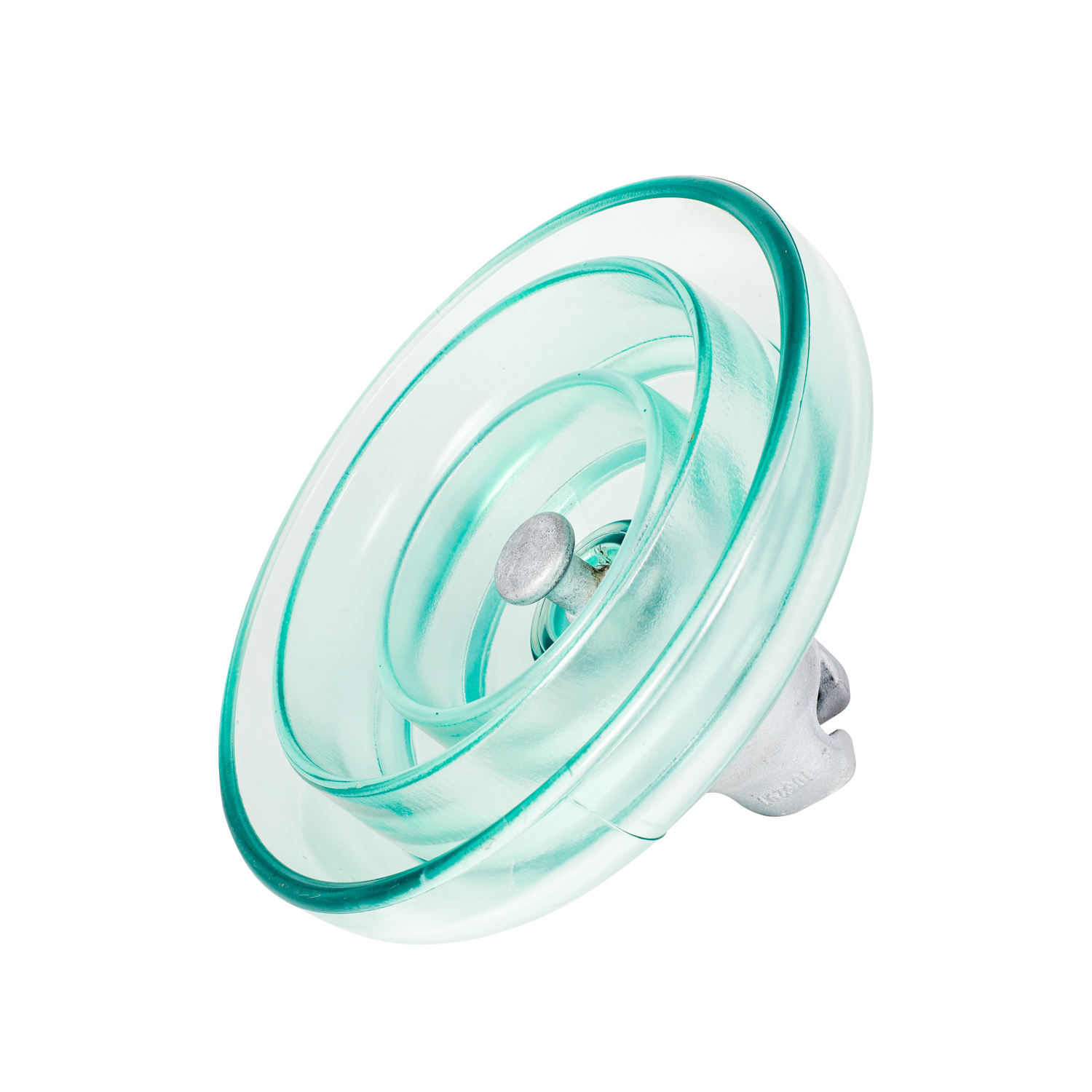
Global grid networks stretch across highly diverse and harsh climates. Standard insulator profiles cannot survive every environmental extreme. You need specialized physical configurations to ensure operational longevity.
Coastal areas and heavy industrial zones introduce severe airborne contamination. Salt fog, chemical emissions, and industrial dust settle rapidly on the dielectric shell. Engineers combat this using a specialized anti-pollution profile. The industry calls this the "Fog Type" design. These unique units feature much deeper and significantly wider glass skirts. The pronounced under-ribs physically extend the available creepage distance.
Think of an offshore wind farm transmission line. The constant ocean breeze coats everything in highly conductive salt mist. Standard shallow-skirt insulators quickly succumb to tracking and flashovers in these zones. A longer creepage path prevents moisture and contaminants from forming a continuous conductive trail. This design drastically minimizes dangerous surface leakage currents. Ultimately, you avoid catastrophic flashover risks during heavy coastal fog or light industrial rain.
Direct current (DC) transmission environments introduce another unique grid threat. Polluted and consistently wet conditions rapidly accelerate pin corrosion. Leakage currents cause the steel pin to thin over time. If left unchecked, the mechanical load rating drops to dangerously low levels.
Consider a high-voltage direct current (HVDC) line spanning hundreds of miles. DC systems constantly push ionic currents in a single direction. This creates a powerful electrolytic effect. It literally eats away standard galvanized steel pins. Manufacturers solve this by integrating advanced zinc sleeve technology. They fuse a highly pure (greater than 99.8%) zinc collar directly to the steel pin. This collar acts as a dedicated sacrificial anode. The harsh environmental currents attack the soft zinc instead of the structural steel. This brilliant chemical defense preserves the mechanical rating of your hardware over decades of continuous service.
Utility procurement requires strict adherence to international engineering benchmarks. You cannot evaluate overhead line hardware based on price tags alone. Safety demands rigorous specification matching.
Every unit carries a highly specific electromechanical rating. The power industry maps these standard designations from U40B up to U550B. A common utility benchmark relies heavily on the 120kN disc suspension insulator. This specific model handles the typical mechanical loads found in standard regional transmission spans. Ultra-high-voltage lines step up to much higher tensile load capacities. They frequently require units rated at 400kN or 530kN to support massive conductor bundles.
Field components face massive daily temperature swings. Rigorous factory testing ensures thermal-mechanical reliability. Top-tier quality manufacturers subject their assemblies to brutal thermal shock cycles. They routinely test assembled units from -40°C straight up to +200°C. This extreme thermal stress testing ensures the glass and cement assembly do not develop hidden stress concentrations. The internal bonding cement must cure perfectly. Flawless curing prevents micro-cracking during deep winter freezes.
Always demand highly transparent documentation from your chosen vendors. Buyers must explicitly require test reports proving absolute compliance with global standards. Do not accept internal factory standards as a substitute for international validation.
IEC Standard | Engineering Focus Area | What It Ultimately Ensures for the Buyer |
|---|---|---|
IEC 60305 | Physical Dimensions | Guarantees global interoperability of disc profiles across different utility networks. |
IEC 60120 | Hardware Couplings | Standardizes ball-and-socket locking connections for safe and seamless installation. |
IEC 60797 | Mechanical Testing | Verifies the ultimate tensile load limits before a structural failure occurs. |
Massive grid expansions require highly synchronized supply chains. You must scrutinize vendor manufacturing capabilities closely before signing large-scale utility contracts.
Guide your procurement buyers to evaluate suppliers based on modern automation levels. The best factories utilize fully automated tempering ovens. They also employ highly precise kiln control systems. You want manufacturing partners who mandate 100% routine mechanical and electrical testing on their lines. This rigorous operational approach ensures strict lot-to-lot consistency. Human error drops significantly when automated testing replaces manual spot checks.
Material traceability remains a critical vendor qualification metric. High-quality production requires incredibly strict raw material tracking protocols. If a factory loses track of incoming silica or alkali batches, systemic impurities arise. Without tracking, bad batches get mixed into the production line. Comprehensive traceability prevents these chemical flaws from ever reaching your transmission towers.
Engineering, Procurement, and Construction (EPC) firms require massive operational efficiency. Sourcing varied components from multiple scattered factories delays project timelines severely. You should frame your procurement process strategically. Look for experienced manufacturers holding broad, highly capable portfolios.
For instance, sourcing your primary overhead hardware from a top-tier vendor simplifies project management. It often aligns perfectly with sourcing heavy substation transition hardware. A capable supplier can bundle your primary transmission line order with a highly reliable porcelain transformer bushing. You might also need an ANSI transformer bushing for domestic grid integration tasks. Substation enclosures frequently require a specialized HV dry wall bushing to safely route live cables inside utility buildings.
Procuring these critical insulating elements together streamlines your vendor qualification process. It heavily accelerates Factory Acceptance Testing (FAT) schedules. Finally, unified purchasing dramatically optimizes your global shipping logistics and reduces customs friction.
This high-voltage technology represents far more than a basic utility commodity. It stands as a highly strategic infrastructure choice. Utilizing these advanced materials effectively mitigates severe environmental risks. It also actively protects your grid integrity over several decades.
Here are the critical takeaways and action-oriented next steps for your upcoming infrastructure phase:
Transitioning to toughened glass decisively mitigates flashover risks in heavy pollution zones.
Replace costly, heavy climbing inspections entirely with visual drone sweeps.
Audit prospective supplier test reports thoroughly for robust thermal-mechanical performance data.
Request official IEC compliance certificates to verify all dimensional and mechanical vendor claims.
Evaluate a vendor's true daily production capacity and standard lead times before initiating any large-scale RFQs.
A: Several distinct factors cause spontaneous shattering. Internal stress imbalances occasionally occur. Microscopic nickel sulfide impurities from the manufacturing process cause these hidden imbalances. External electrical factors also trigger field failures. Localized arcing or severe flashovers compromise the dielectric shell rapidly. Finally, extreme physical impact from flying debris causes breakage. Reputable manufacturers implement rigorous factory quality control. They use advanced thermal shock testing to force defective units to break internally before shipping. This strict screening limits actual field failures to an exceptionally small, highly acceptable fraction.
A: No, the color does not change the core dielectric strength. Manufacturers produce units in blue, green, or clear visual variations. The base glass material maintains identical electrical insulation properties regardless of the chosen tint. However, tinted glass does offer minor secondary field benefits. It can marginally improve long-term ultraviolet (UV) resistance. It also reduces direct sunlight glare for your maintenance crews. Primarily, grid operators use specific colors as a quick manufacturer identifier. Some utilities select specific tints simply to blend better visually with local natural landscapes.
A: The primary difference lies in the physical geometry of the dielectric shell itself. Standard baseline profiles feature relatively shallow under-ribs. Fog types incorporate highly pronounced, much deeper glass skirts. This optimized physical design drastically increases the surface creepage path. A significantly longer path effectively prevents moisture, industrial dust, and coastal salt from forming a continuous conductive trail. By physically breaking this conductive path, fog-type units prevent surface leakage currents. They significantly minimize dangerous flashover risks in heavily polluted or extremely humid environments.


