
- All
- Product Name
- Product Keyword
- Product Model
- Product Summary
- Product Description
- Multi Field Search
Email: sales@njrecgroup.com
Views: 0 Author: Site Editor Publish Time: 2026-07-01 Origin: Site
Transformer bushings act as the vital gateways for electrical power entering and exiting a transformer. These components often appear straightforward. Yet, they account for a disproportionate percentage of catastrophic transformer failures and unplanned outages. Selecting the right component requires critical risk-management. It is not simply a routine line-item purchase. Procurement teams face immense challenges in today's global supply chain. You must navigate long lead times and verify exact dimensional interchangeability for older replacements. Furthermore, buyers must separate genuine manufacturing capabilities from mere private-labeling distributors.
This guide provides a clear, engineering-aligned framework for evaluating technical specifications. We help you assess supplier credibility and mitigate implementation risks when sourcing compliant components. You will learn practical strategies to navigate material choices and avoid costly installation errors. We aim to equip your team with the knowledge required to confidently secure reliable assets.
Strict adherence to IEEE/ANSI standards (e.g., C57.19.00 and C57.19.01) is the non-negotiable baseline for thermal and electrical performance.
Material selection (Porcelain vs. OIP vs. RIP/RIS) fundamentally dictates maintenance intervals, seismic resilience, and lifecycle costs.
Selecting a qualified ansi transformer bushing manufacturer requires auditing their in-house routine testing capabilities, type-test validity, and supply chain transparency.
Retrofitting and replacement projects demand exact dimensional matching (draw-lead vs. bottom-connected) to avoid costly on-site flange modifications.
Procuring a reliable ANSI standard transformer bushing requires a deep understanding of the underlying regulatory framework. You must look beyond basic dimensions and examine specific performance criteria. The industry heavily relies on IEEE standards to define these parameters. IEEE C57.19.00 establishes the general requirements for all electrical bushings. It covers basic operating conditions, test procedures, and thermal limits. Meanwhile, IEEE C57.19.01 dictates the specific performance characteristics required for power transformers.
Compliance involves much more than initial design geometry. It centers on rigorous testing tolerances. Manufacturers must conduct partial discharge (PD) testing and power factor evaluations under strict, standardized conditions. High partial discharge levels indicate microscopic voids within the insulation. Over time, these voids cause progressive dielectric degradation. Strict adherence to PD limits ensures long-term insulation stability. Similarly, power factor testing measures the dissipation factor. High dissipation values often reveal moisture ingress or severe material contamination during production.
Field engineers and procurement teams must accurately interpret nameplate data. You need to verify the voltage rating (kV), Basic Impulse Level (BIL), and maximum continuous current rating against your specific facility requirements. A mismatch between nameplate capabilities and actual utility demands often leads to rapid thermal failure. Always cross-reference the manufacturer's stated tolerances with your local grid conditions before authorizing a purchase.
Electrical and mechanical stresses vary significantly across different voltage classes. Selecting the proper design requires profiling your application accurately. Low voltage applications typically operate at or below 34.5 kV. In these scenarios, the primary engineering focus shifts toward bulk mechanical strength. High-current environments generate immense heat. A robust low voltage bushing must manage this thermal output effectively. You must also evaluate indoor versus outdoor creepage requirements carefully. Dust and moisture accumulations demand appropriate shed designs to prevent surface tracking.
Conversely, high voltage applications usually operate at or above 69 kV. The physics of electrical stress change dramatically at these levels. A reliable high voltage bushing requires sophisticated internal capacitance grading. Manufacturers embed conductive foils within the insulation core. These foils distribute the electric field evenly across the entire structure. This prevents dielectric breakdown near the mounting flange. Thermal stability becomes critical as voltages increase. Advanced insulation technologies prevent the core from overheating under continuous electrical stress.
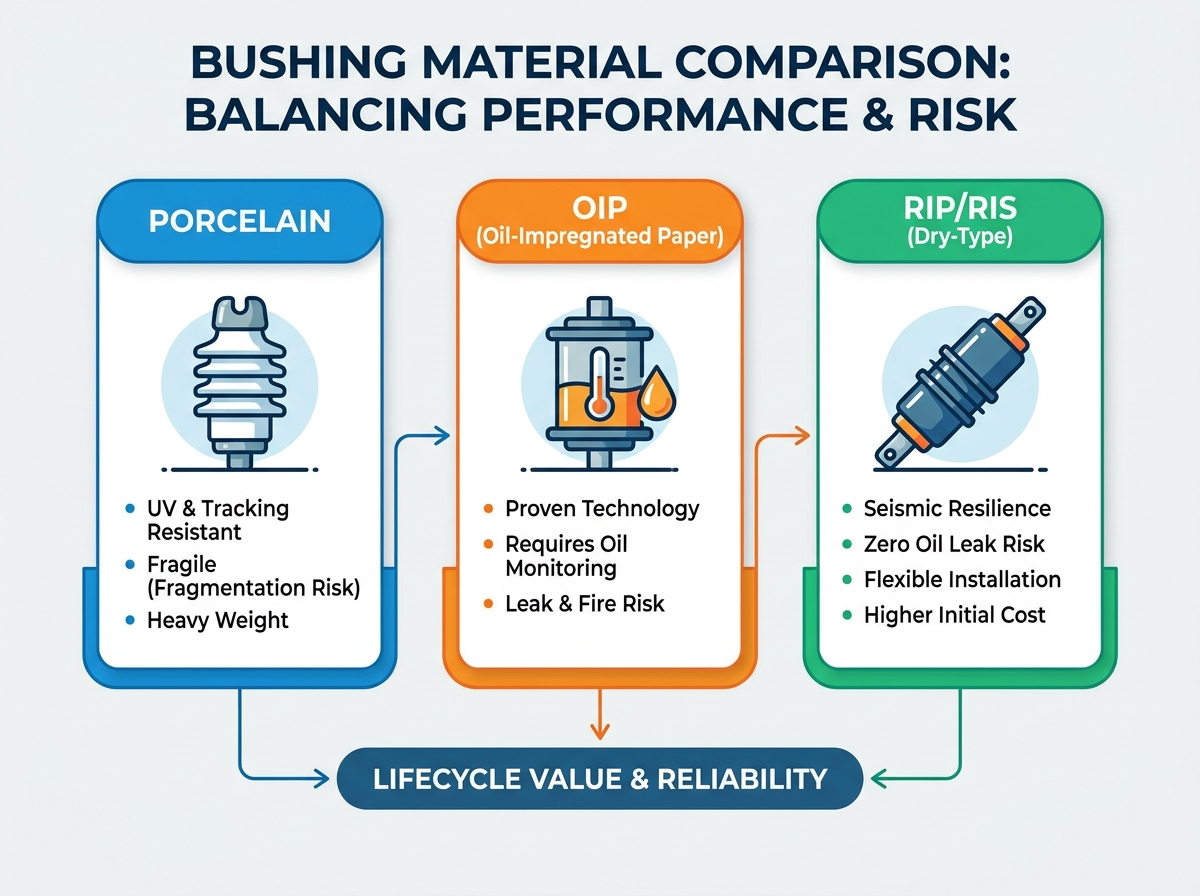
Material science fundamentally dictates operational resilience and maintenance schedules. The industry utilizes several distinct insulation technologies. The traditional porcelain transformer bushing remains the historical standard across many global utilities. Porcelain offers exceptional resistance to ultraviolet (UV) radiation and surface tracking. However, it requires careful handling during installation to prevent unseen micro-cracking. Furthermore, porcelain poses severe fragmentation risks during a catastrophic internal failure.
Oil-Impregnated Paper (OIP) represents a proven, widely adopted technology. OIP designs utilize layers of high-grade electrical kraft paper saturated in dielectric oil. While reliable, they demand regular maintenance. Technicians must monitor oil levels continuously to prevent dry spots. They also carry inherent leak and fire risks if the outer housing sustains damage.
Resin-Impregnated Paper (RIP) and Resin-Impregnated Synthetics (RIS) offer modern, dry-type alternatives. RIP technology cures the paper core in solid epoxy resin. RIS uses synthetic non-woven materials instead of paper. Both eliminate oil entirely. They provide superior seismic performance and eliminate fire hazards. They also allow flexible installation angles, unlike gravity-dependent OIP models. These benefits typically require a higher initial capital expenditure, but they dramatically enhance safety.
Insulation Material | Key Advantages | Primary Limitations |
|---|---|---|
Porcelain | Highly UV resistant, excellent track resistance, long historical track record. | Brittle structure, heavy, risk of catastrophic fragmentation during failure. |
OIP (Oil-Impregnated Paper) | Proven electrical performance, relatively cost-effective production. | Requires regular oil monitoring, leak potential, significant fire hazard. |
RIP / RIS (Dry-Type) | Zero oil-leak risk, excellent seismic resilience, flexible installation angles. | Higher initial capital expenditure, requires strict moisture control during storage. |
Engineers cannot evaluate a power transformer bushing based on dimensions alone. You must scrutinize several interrelated electrical and mechanical criteria to guarantee field reliability.
Basic Impulse Level (BIL): This metric defines the insulation withstand capability against transient overvoltages. You must match the BIL to your local grid conditions. Facilities located in areas prone to severe lightning activity require enhanced BIL ratings. Failing to specify adequate BIL invites catastrophic flashovers during storm events.
Creepage Distance & Pollution Severity: The external shed design determines surface flashover resistance. You must evaluate site-specific environmental contaminants carefully. Coastal areas expose equipment to heavy salt spray. Industrial zones produce conductive dust. Follow IEEE guidelines to specify extended creepage distances for highly polluted environments.
Thermal & Current Ratings: The internal conductor must handle maximum continuous operating currents safely. Additionally, it must endure temporary overload conditions without exceeding allowable temperature rises. Excessive heat deteriorates internal insulation rapidly. Always confirm the connection type can dissipate heat efficiently.
Cantilever Strength: Mechanical load capacity is often overlooked. The unit must withstand heavy busbar connections pulling horizontally. Wind loads and seismic events add extreme dynamic stress. Adequate cantilever strength prevents the mounting flange seal from rupturing under pressure.
Ignoring any of these criteria compromises the entire transformer. A comprehensive technical evaluation ensures the asset withstands daily operational stresses and sudden environmental anomalies.
Selecting a credible ansi transformer bushing manufacturer minimizes procurement risks significantly. Many distributors re-brand generic components without maintaining proper engineering oversight. Use the following five-step audit framework to verify true manufacturing capabilities.
Examine In-House Testing Facilities: Ask about their routine testing infrastructure. Do they perform 100% routine testing on every unit produced? Validating capacitance, power factor, and partial discharge requires a certified, electromagnetically shielded high-voltage laboratory. Background electrical noise invalidates PD test results.
Demand Valid Type Test Reports: Do not accept self-certified legacy data. Demand recent, valid type-test certificates from recognized independent laboratories. Institutions like KEMA or CESI provide unbiased verification of extreme thermal and electrical performance. Outdated certificates often fail to cover modern resin or paper material variations.
Evaluate Supply Chain Control: Ask where they source critical raw materials. A robust manufacturer tracks electrical-grade kraft paper, epoxy resins, and high-alumina porcelain back to the original source. Supply chain transparency prevents substandard materials from degrading final product quality.
Assess Customization and Reverse Engineering: Replacing obsolete OEM components requires significant engineering depth. Does the supplier possess the capability to provide exact interchangeable replacements? They should offer 3D scanning or advanced modeling to match old flange dimensions without requiring costly tank modifications.
Review Lead Times and Inventory Strategies: Assess their production scalability. Determine whether they operate strictly on a build-to-order model or hold strategic stock. A reliable partner maintains an inventory of critical spares to support emergency utility replacements swiftly.
Thorough supplier vetting separates reliable engineering partners from transactional vendors. Conduct facility tours or virtual technical audits whenever possible.
Even the highest quality component will fail if installed incorrectly. Field implementation introduces numerous mechanical and environmental risks. Dimensional interchangeability serves as the most critical retrofit factor. You must precisely match the maximum internal envelope and the lower end length. The flange bolt circles must align perfectly with the existing transformer tank. Even minor dimensional discrepancies force field crews to modify the tank onsite. This introduces metal shavings into the transformer oil and extends outage times exponentially.
You must differentiate between connection topologies early in the procurement phase. Draw-lead designs allow a flexible cable to pull upward through the hollow center tube. This simplifies installation because crews do not need to drain massive amounts of oil to make the connection. Bottom-connected designs feature a fixed lower terminal. Crews must enter the transformer tank or lower the oil level significantly to bolt the internal leads. Choosing the wrong connection topology derails project timelines.
Proper storage and handling dictate initial energization success. You must follow best practices for vertical versus horizontal storage. OIP units generally require vertical or slightly angled storage to keep the paper insulation fully submerged in oil. RIP and RIS dry-types demand strict protection against moisture ingress before installation. Always conduct pre-installation testing. Perform Doble power factor testing and Megger insulation resistance testing immediately before mounting the unit. These tests confirm the component sustained no internal damage during transit.
Securing reliable components demands a structured, technically rigorous approach. You must carefully balance material technology against your specific operational environment. Weigh the historical reliability of porcelain against the superior seismic and fire-safe properties of dry-type resins. Precise alignment of electrical parameters, such as BIL and creepage, prevents premature degradation. Furthermore, rigorous supplier vetting eliminates the risks associated with poor quality control and opaque supply chains.
We recommend taking proactive steps today. Map out your current transformer fleet's bushing inventory immediately. Identify critical aging assets. Request exact dimensional drawings for essential spares to avoid emergency reverse-engineering delays. Finally, initiate detailed RFQs that explicitly require full routine test documentation from shielded laboratories. Proactive preparation prevents catastrophic outages tomorrow.
A: Procurement timelines depend heavily on material type and voltage class. Standard configurations often require 12 to 16 weeks. However, highly customized dimensions or extreme high-voltage classes can extend lead times to 30 weeks or more. We highly recommend maintaining strategic spares for critical assets.
A: Yes, you can retrofit older OIP models with modern RIP dry-types. However, you must carefully match the exact flange dimensions, lower end length, and connection topology. You must also account for weight differences, as RIP units sometimes alter the mechanical stress on older transformer tank covers.
A: A comprehensive factory test report must include several mandatory measurements. Expect to see Power Factor (Dissipation Factor) readings, total Capacitance measurements, and Partial Discharge levels. These tests must be performed on 100% of the units prior to shipping to verify internal insulation integrity.
A: Engineers generally expect an operational lifespan of 25 to 40 years. However, this lifespan varies heavily based on the operating environment. Coastal pollution, frequent transient overvoltages, lack of maintenance, and severe thermal overloading will drastically reduce the functional life of the insulation.


